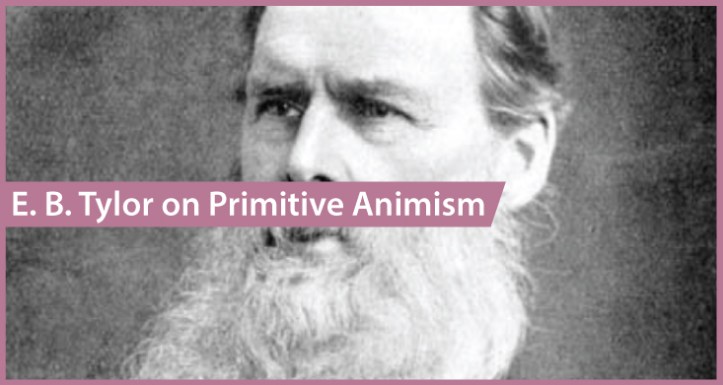
Edward Burnett Tylor (1832–1917) was a British anthropologist and the father of cultural anthropology. He conceived influential theories of cultural evolution, inspired by Charles Darwin (1809–1882), some of which include the evolution of religious belief. It is with respect to the latter that Tylor’s ideas have been of interest to scholars of religion.
Scientific Approach to Studying Religion
Tylor believes that religion can be approached in an objective, scientific sense because religions themselves attempt to provide an objective account and explanation of the world. Religious claims can either square with reality or fail in light of it. Either way, religion is open to being compared to objective reality and measured against empirical observation. This approach lies behind Tylor’s evolutionary chronicle of human culture and religious belief, as well as his theory of animism as the most “primitive” religious belief.
“Primitive” Religion as Animism
Tylor penned a two-volume work Primitive Culture (1871). The first volume, The Origins of Culture, is primarily ethnographical and deals with topics of linguistics, myth, and social evolution. The second volume, Religion in Primitive Culture, deals with religious belief and the theory of animism.
Tylor’s primary purpose is to understand the religious life of the “primitive” peoples. He argues that animism constituted the earliest religious belief and that these beliefs came into existence as a result of the projection of the ordinary experiences of powerful people onto a supernatural realm. One example is that people came to believe that the world was created by the gods or a God because they witnessed people making things in their daily lives and thus projected this onto the supernatural.
To Tylor, this is the most obvious reading of the data given that ancient religions and religious believers so frequently invoke the existence of spirits, souls, and gods to explain events in the world. Religion, across the board from the so-called “primitive” to the “modern,” encompasses belief in spirits and spirit agencies. By “primitive religion”, Tylor specifically means the beliefs of hunter-gatherers who made use of stone tools. Tylor sees such historical people to be at a lower level in their development than modern human beings.
Dislike for Religion and Christianity
Despite his Quaker background, Tylor disliked religion, particularly the Anglican Church, which constituted the external context in which he theorized. It is likely that these sentiments influenced his animistic theory, for he was aware that Christianity teaches the existence of one God, but if his animistic theory is true, then it would undermine the uniqueness of this teaching and its purported truth.
Tylor’s theory essentially suggests that belief in spirits, gods, and God are all the same and that what modern Christians believe God to be is actually just an evolution of the once-held belief in the spirits of ancient people. Tylor argues that Christian beliefs, particularly those held by Mexican Catholics, resemble the “primitive” ones shared by the ancient animists. He specifically points out the similarities the Catholics have with the behaviors of the animistic people who communicated with gods as a means to obtain their favor and for success in their enterprises.
Tylor believes that for primitive people, animistic beliefs are understandable as they likely occur due to dreams and from observations of death and dying, but that does not mean that they conform to objective reality.
Tylor’s Evolutionary Chronicle
Tylor realized the need to explain how his animism and modern religions fit into his evolutionary chronicle of human culture. He proposes that human culture moves through three stages: savagery, barbarism, and civilization.
Following the discoveries of pre-historic human remains in Brixham Cave (England) and his attempt to divide human cultural development into stages of periodization, Tylor contends that he is able to examine more closely different periods within human history.
He treats with primacy the first stage, where he situates and subsequently examines primitive culture within human development. He compares modern, civilized people with primitive, savage people by identifying cultural forms, artifacts, and expressions that include language, mythology, custom, and religion.
By analyzing these primitive “vestiges,” Tylor thinks he can reconstruct the society and culture of earlier times. However, he notices that in certain cases, the development from the primitive to the modern has not fully occurred, while in other places, primitive culture has been left entirely behind.
This is perplexing: why are animistic beliefs associated with primitive people of ancient times still believed in by contemporary religious people? Were contemporary religious people not more aware of science? Yet they still believe in God, spirits, and deities. Tylor reasoned that some modern religious people had not progressed from primitive belief and were in fact left behind on a lower stage of mental evolution, perhaps akin to how some people have not developed emotionally beyond their adolescent years.
Tylor is one of several prominent historical theorists to promote the idea that modern religious belief is an evolution from prior beliefs. Also see Raffaele Pettazoni, James Frazer, and Herbert Spencer.
 Bishop's Encyclopedia of Religion, Society, and Philosophy
[…] of human existence which evidenced a progressive development that could be tracked back in time. E. B. Tylor (1832-1917), a British anthropologist and the father of cultural anthropology, conceived […]
[…] prehistorical clans and tribes. He wasn’t the first to examine totems given that others such as E. B. Tylor (1832-1917) and James Frazer (1854-1941) already showed interests in sacred objects among […]
[…] his work Primitive Culture (1871), the anthropologist E. B. Tylor (1832-1917) claimed religion’s origin to be in the animistic beliefs. These constituted the earliest forms of […]
[…] and growth of religion (5). As such, Smith proposed a developmental-evolutionism approach like E. B. Tylor to the study of religion. For example, he suggested that the “primitive” rites of totemism and […]
[…] can be added to a reservoir of other theorists who forwarded similar evolutionary ideas, such as E. B. Tylor, James Frazer, and Herbert […]
[…] have looked at Edward Burnett Tylor before in an article that would be much more pleasant for those who enjoy a briefer read. This […]
[…] the Great Systems (1895), he claims that religion requires time to develop. It begins with tribal animism and develops into a national religion, then to individual religion, and finally to universal […]
[…] men” of the Europeans. For example, the British anthropologist E. B. Tylor claimed that animism was the religion of the “savages” that continued to evolve up until the age of “civilized […]
[…] to have held religious beliefs, even if these were somewhat vague and included as much magic and animism as Christianity, and thus through belief, if not through practice, these were religious societies […]
[…] numerous hypotheses have been proposed for why human beings believe in God. Some have argued that animism explains the rise of religions, whereas others note a primordial monotheism or polytheism. The […]
[…] practices, closely linked to animism, were based on the belief that that spirits could be influenced by shamans, special men and women […]
[…] a Supreme Being. By consequence, he was particularly critical of evolutionist accounts proposed by E. B. Tylor, Herbert Spencer, and other developmentalists. Schmidt did not agree that later religious belief […]