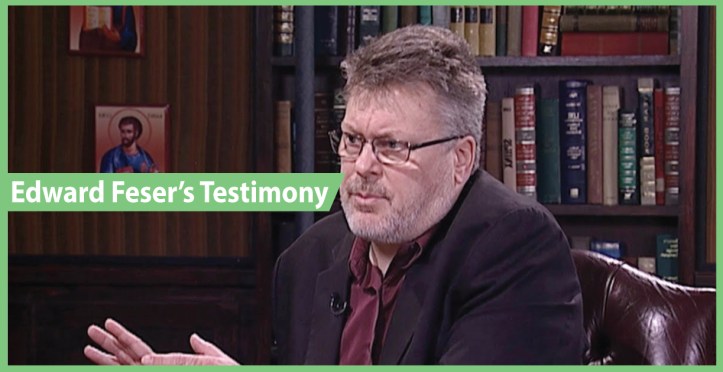
Edward Feser is a well-known scholar in his field whose academic work has touched on several areas, including the philosophy of religion, philosophy of mind, and metaphysics.
Feser is the Associate Professor of Philosophy at Pasadena City College, previously a Visiting Assistant Professor at Loyola Marymount University, and a Visiting Scholar at the Social Philosophy and Policy Center. He has authored many books, some of which include The Last Superstition: A Refutation of the New Atheism (2008), Aquinas: A Beginner’s Guide (2009), Scholastic Metaphysics: A Contemporary Introduction (2014), and Five Proofs of the Existence of God (2017)
Feser explains that he was once an atheist and philosophical naturalist before he converted to Christianity. He says that his transition away from atheism “was no single event, but a gradual transformation.” Feser was brought up Catholic but lost his faith around the age of thirteen or fourteen. His atheism accompanied him well into his university years as a philosophy student.
While attending university, Feser became interested in existentialist philosophers, particularly Søren Kierkegaard (1813–1855). This interest led him to other existentialists such as Friedrich Nietzsche (1844–1901) and Walter Kaufmann (1921–1988). The atheist analytic philosopher J. L. Mackie (1917–1981) also appealed to Feser, and he considered Mackie’s book The Miracle of Theism (1982) to be a solid piece of philosophical work. Mackie’s book, explains Feser, is “intellectually serious, which is more than can be said for anything written by a “New Atheist.”” The atheist philosopher Kai Nielsen’s work on the topic of morality appealed to him too. For a time, atheism seemed very obvious for Feser,
“What really impressed me was the evidentialist challenge to religious belief. If God really exists there should be solid arguments to that effect, and there just aren’t, or so I then supposed… Atheism was like belief in a spherical earth — something everyone in possession of the relevant facts knows to be true, and therefore not worth getting too worked up over or devoting too much philosophical attention to.”
But Feser explains that when he studied analytic philosophy in greater detail, it would bring his “youthful atheism down to earth.” Feser’s transition away from atheism began when he first looked into the philosophy of language and logic. Over several years in which Feser was weighing up arguments, he came to see that existing naturalistic accounts of language and meaning failed,
“I already knew from the lay of the land in the philosophy of language and philosophy of mind that the standard naturalist approaches had no solid intellectual foundation, and themselves rested as much on fashion as on anything else.”
Feser moved towards Aristotelianism, notably where ethics is concerned, and then towards Platonic realism. The further he progressed in this philosophical journey, the more he discovered that atheistic philosophical materialism “was shallow and dogmatic” and that “Naturalism came to seem mysterious at best.” But he sustained his “commitment to naturalism for some time.”
While a student, Feser was provided the opportunity to teach a philosophy of religion course. Teaching in this area required him to teach the arguments for and against the existence of God as presented by famous historical figures like Anselm of Canterbury (1033–1109) and Thomas Aquinas (1225–1274) to his students.
As an atheistic naturalist, Feser taught students arguments against theism. He says he “taught the material the way so many professors do: Here are the arguments; here are the obvious fallacies they commit; let’s move on.” But Feser was taken aback by the fact that many of these historical people he taught to his class “were obviously not stupid.” This challenged his atheism.
“So, it seemed to me that it would be interesting to try to give the arguments a run for their money, and to try to make it understandable to the students why anyone would ever have accepted them… I still didn’t agree with the arguments, but at least teaching them was getting interesting.”
Over time, Feser found the arguments for God’s existence compelling,
“As I taught and thought about the arguments for God’s existence, and in particular the cosmological argument, I went from thinking “These arguments are no good” to thinking “These arguments are a little better than they are given credit for” and then to “These arguments are actually kind of interesting.” Eventually it hit me: “Oh my goodness, these arguments are right after all!”
Feser felt that he could no longer rationally sustain his philosophical naturalism. Not much later, he was trying to convince his wife’s skeptical physicist brother-in-law of philosophical theism while on a train trip through Eastern Europe.
Feser concludes his testimony,
“When I was an undergrad I came across the saying that learning a little philosophy leads you away from God, but learning a lot of philosophy leads you back. As a young man who had learned a little philosophy, I scoffed. But in later years and at least in my own case, I would come to see that it’s true.”
 Bishop's Encyclopedia of Religion, Society, and Philosophy
Feser’s work has been very influential in convincing me of the soundness and validity of the Thomistic- Aristotelian tradition of philosophy.
Good to hear. He is a great and humble philosopher.
Not sure what you mean by “humble philosopher.” He comes up with ad hoc excuses. https://edward-t-babinski.blogspot.com/2018/05/eternal-damnation-as-gods-metaphysical.html
Reblogged this on Talmidimblogging.
[…] FOLLOW THE LINK BELOW TO READ THE FULL ARTICLE: Former Atheist & Philosophy Professor Edward Feser On How Studying Philosophy Convinced Him of G… […]
[…] Read the Whole Article […]
[…] Read the Whole Article […]
This is a good story on one man’s testimony from atheism to Christianity. However, there was no real point on what actually led him there other than a vague point. I wanted to read this article to understand his point of view. Publishings such as The Case for Easter by Lee Stroble had more sound facts and reasoning. This would be a great example for another article such as this! Thank you for your insight and interest on this subject!
[…] Edward Feser, philosophy professor, Pasadena City College: […]
[…] Edward Feser , professor de filosofia, Pasadena City College: […]
[…] Former Atheist & Philosophy Professor Edward Feser On How Studying Philosophy Convinced Him of G… […]
[…] https://jamesbishopblog.com/2018/12/21/former-atheist-philosophy-professor-edward-feser-on-how-study… […]