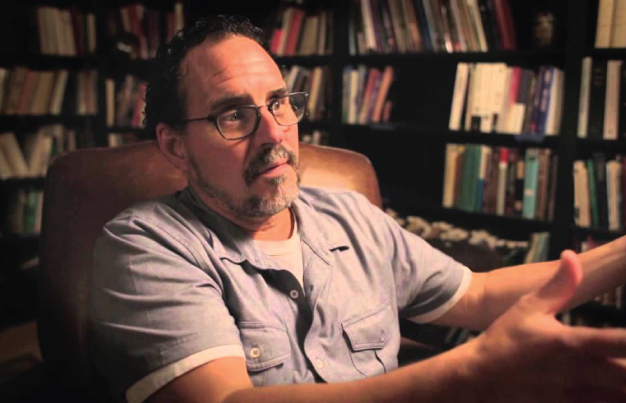
A former atheist, Greg Boyd is currently the senior pastor of Woodland Hills Church in Minnesota and is also a professor of theology at Bethel College.
He has authored books on the topics of Satan, the problem of evil, spiritual warfare, and the demonic (1). His academic efforts in the sphere of New Testament scholarship have been recognized, and he has also been involved in the Quest for the Historical Jesus (2).
Boyd has engaged in formal debates with, perhaps most notably, the likes of mythicist Robert Price (3) and atheist Dan Barker (4). Boyd is also a contributor to the BioLogos Foundation and has written extensively in favor of Christianity and evolution (5).
Boyd’s professor, an atheist, told him that the ideas of the French philosopher Albert Camus (1913-1960) helped him find meaning in life where none existed. The professor believed that Camus would also be of help to Boyd, despite the meaninglessness of life. According to Boyd, Camus believed that “life is irrational, absurd, meaningless, pointless, and it’s painful. And that one could make a rational case that we should commit suicide.”
Although a nihilist himself, Boyd was confusion how his professor embraced such a pessimistic view and still was able to draw any meaning from it. It was also the first time Boyd started to question his own nihilistic views,
“[I]f the universe has no value and is meaningless then who cares if you’re courageous, valiant, and heroic or not? Where did that value come from?… Why do we try and do anything if it all comes to nothingness?”

In a café close to his university, Boyd discovered, having read Camus, that he felt a longing for something that he believed did not exist. In that moment, he thought deeply in hope of making sense of his atheistic worldview. Instead, he discovered that on atheism, it seemed like “evil wins” in the end: “Death is the last word, it all comes to nothingness, all our hopes and dreams to make the world a better place come to nothing.”
At the core of who he is, Boyd felt a huge desire for meaning. There was a love for doing meaningful things and a desire to make sense of life. He wanted good to triumph over evil. But if the universe was simply meaningless and absurdly existed for no reason, “then reasoning, meaning, and morality have no place in it.” This raised important questions.
- “How did an irrational universe produce a rational being?”
- “How did a meaningless universe produce a meaningful being?”
- “How did an amoral universe produce a moral being?”
- “How did the universe create a being that longed for things that don’t exist?”
As Boyd poignantly asks, “how do you explain me?” Atheism failed to answer this question:
“When you look around the pattern in nature, nature produced beings that have longings that it supplies. We’re hungry and there’s food, we get thirsty and there’s water, and we have sex drives and there’s sex. Well, where did this longing for meaning, and for goodness, and for reason come from? It’s like having a drive for a fruit that doesn’t exist, it is an insatiable drive.
He supplies an analogy:
Think of it like this. If I went to the Amazon and followed some Amazon people who were making skis, and waxing skis, and they kept talking about snow, and were longing to go snow skiing. This was a deep drive for them to the point that some people were committing suicide because they can’t go snow skiing. Well, you’d have to explain that. Somewhere along the line these people got the idea that snow exists and that snow was a good thing if though it was an unnecessary thing because it doesn’t snow down in the Amazon.”
Boyd offers another deep thought,
“How do you explain human beings who commit suicide because life is meaningless and pointless? If the universe is meaningless and pointless then that should be the most natural and easy conclusion in the world? If God does not exist, [and] as Nietzsche and Sartre admit, then why is being a consistent atheist the hardest thing in the world? Jean Paul Sartre towards the end of his life and in an essay, Existentialism and Atheism, he says being an atheist that’s consistent with integrity is the hardest thing imaginable, I’ve tried to live it out to the very end.”
“Why is it so difficult,” asks Boyd, “if it is in fact the natural conclusion?”
Boyd concluded that it is only the Christian worldview drawn from biblical scripture that makes sense of human existence.
“[But] if we are made in the image of God then everything makes sense. I can understand why I am rational, and how I long for meaning, and how I want good to triumph over evil. If I am made in the image of a God who is mind itself and whose very being is moral, personal, purposeful, and meaningful then I can make sense [of existence]. If there is no God then life is absurd, painful, and there is no explanation for anything.”
But it was not just philosophical ideas that convinced Boyd that life has meaning. He also invests much in the historical evidence for Jesus Christ and supports the general reliability of the gospels.
“The reason I believe that Jesus is the ultimate revelation of that God is that a lot of it has to do with all the historical evidence that supports the general reliability of the gospels… the story of Jesus, if you understand it rightly, represents the greatest love story ever told because it is a story of an all holy, omnipotent God becoming a human being and dying a godforsaken hellish death on the cross out of a love for people who couldn’t deserve it less.”
References.
1. Willems, K. 2009. Recommended Resources: “Spiritual Warfare” Series by Greg Boyd. Available.
2. Köstenberger, A. 1998. “Gregory A Boyd: Cynic Sage or Son of God?” in Trinity Journal, 19: 110–14.
3. YoutTube. 2015. #23 Debate – Robert Price vs Greg Boyd – Who Was Jesus? – 2003. Available.
4. FFRF. Dan Barker. Available.
5. Biologos. Greg Boyd. Available.
6. YouTube. 2015. Dr. Greg Boyd: Atheism To Belief. Available.
 Bishop's Encyclopedia of Religion, Society, and Philosophy
Reblogged this on Talmidimblogging.
Boyd was converted while in high school around age 17, and soon became a creationist (and apparently an inerrantist or something like one), but later grew to become a more open-ended and progressive Christian in many of his views, open to “open theism,” even I think open to “universalism,” and unconcerned whether an historical Adam existed or not. He even lists the spectrum of views just within Evangelicalism in his book, Across the Spectrum: Understanding Issues in Evangelical Theology. The 1st ed. of his book rec’d nearly as many one star reviews as five star reviews from Christians, many Christians being upset by all the uncertainties to which he introduced them, though it seems Christians are growing more accepting of uncertainty, or perhaps Boyd has gained more readers who admire his thoughts since the 1st ed. appeared, or maybe a bit of both. One might add that the questions and diversity of opinion are not diminishing in either the Evangelical or Mainstream scholarly world.
Boyd later produced a book and lecture series titled, Benefit of the Doubt: Breaking the Idol of Certainty.