The Aztec Empire (1300–1521 CE) was centralized in its capital city, Tenochtitlan, which is today located at the center of Mexico City, Mexico. This historic settlement has furnished researchers with information about Aztec religiosity, among other sociological, archeological, and cultural features in their magnificent hanging gardens, statues, plazas, pyramidal temples, and white houses.
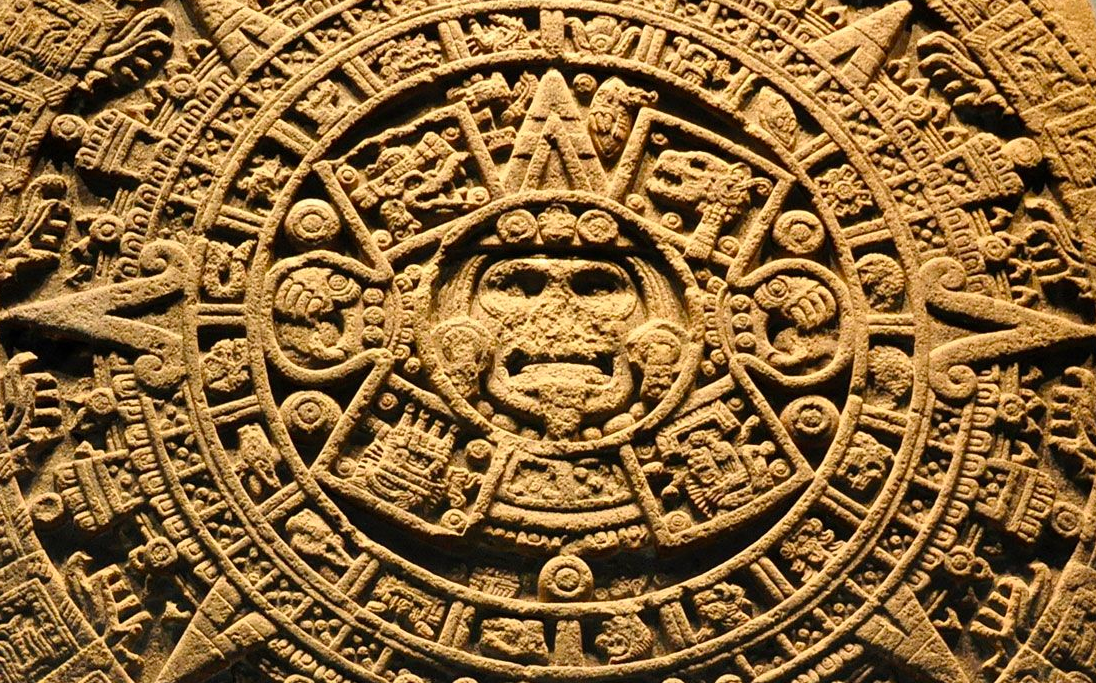
Syncretistic
Aztec religion was syncretistic as it appropriated elements from many other Mesoamerican peoples and cultures.
The Aztecs appropriated from the Mayans (BCE 2000–16th century CE) the belief that the current period was the last in a series of creations, which. This belief functioned prominently in Aztec cosmology. The Aztecs were also not the only Mesoamerican civilization to practice human sacrifice and bloodletting, although for them these became particularly pronounced. Some gods were also borrowed from earlier peoples, such as Quetzalcoatl, who for the Mayans was called Kukulcan.
Polytheism
Aztec religion was polytheistic, based on belief in a pantheon of major and minor deities for whom many temples were built. The Aztecs had a fascination with the sun, which was incorporated into their mythologies, such as their creation story. Cosmological views and beliefs became expressed in art and images of gods and beings believed to control the universe.
A number of major deities were accepted: the creator Ometeotl, who was also conceived as a bisexual god as being both male and female; Tezcatlipoca (“Smoking Mirror”), identified with the knife essential in sacrifice; Xiuhtecuhtli, the god of fire, creator of life, and an important deity for priests responsible for maintaining sacred fires; the goddess Coatlicue (“Snake Skirt”), believed to be powerful in her fertility, decorated with skulls and sacrificial hearts; the warrior god Huitzilopochtlu (“Humming Bird of the South”) who received many sacrifices and was enshrined alongside Tlaloc (“Rain God”) located on top of the great temple pyramid of Templo Mayor in Tenochtitlan; and Quetzalcoatl (“Precious Feathered Serprent”), who was important for the earlier Mayans and, for the Aztecs, the re-creator of the world who invented agriculture and the human arts.
Imaginative myths developed around these gods. Quetzalcoatl, for example, “was the re-creator of the world, inventing agriculture and the various human arts, and diving to the underworld to regain the bones of death; himself dying, he was resurrected, and saved the dead whose bones he reanimated. Around him there developed dramatic myth, concerning his miraculous birth, his evening of his father’s death, his training for the priesthood, his rule as sacred king, the fall of his empire, his fight, and his promise to return one day from the east to restore his rule and universal prosperity” (Smart 1992, 190–191).
Aztec Cosmology
The universe has had five major periods, each of which ends with various disasters and calamities. The Aztecs believed that they were in the fifth major period, or in the Period of the Fifth Sun (Smart 1992, 186). The universe is also unstable, and the Aztecs believed that its continuity required sacrifices, especially blood ones.
“The Aztecs of Mexico carried a heavy spiritual burden. They felt responsible for the continuation of the universe because they were the children of the sun. The Aztecs believed, as did most ancient people, that the gods created their world and the birth of the sun was the most important act. Already there had been four previous suns’- worlds- and each had perished” (Anawalt 1982, 43).
This myth of the fifth period justified the function of the sacrificial cult centered in the capital, Tenochtitlan. Importantly, the Aztec emperor had the role of high priest and the responsibility of maintaining two sets of order: within the empire itself and that of the cosmos. There were also priests who were required to attend the sacred fire to ensure it would never cease burning. A new fire was to be kindled every fifty-two years in the hole of a sacrificial victim’s chest in the place where his heart was before it was removed.
Sacrifice and Uncertainty
Uncertainty permeated Aztec religion. There was never a guarantee for them that the sun would rise tomorrow or that tomorrow would be orderly or free from calamity. The only way to ensure cosmic harmony was to offer blood sacrifices to the gods, especially human sacrifices in the form of hearts. The sacrificial need for human sacrifices became an important feature of Aztec warfare in that they would often, rather than killing their enemies, capture them to ensure a bountiful supply for their gods.
The ritualistic sacrifice was a bloody process that involved cutting out a person’s heart from his or her body (Ambalu 2013).
The heart was significant because it was believed to be a fragment of the sun’s energy and therefore in some way connected to it. To remove the heart from the victim was to return the energy to its source. Four priests held the victim down on a stone slab in the temple, and a fifth performed the cutting and then offered it, still beating, to the gods. The offering was made in a vessel called a Cuauhxicalli (“eagle gourd bowl”), and the victim’s body was then rolled down the stairs to the stone terrace at the base. There the head would be removed, as would sometimes the arms and legs. Skulls were displayed on a skull rack.
The Templo Mayor
The impressive and imposing Templo Mayor, which was destroyed in the Spanish Conquest of the early sixteenth century CE, had an important place in Aztec religion as shown in its centralized location in the empire’s capital.
The temple would have been the tallest feature of the city’s skyline and was dedicated to the gods Huitzilopochtlu and Tlaloc for whom two towers topping the structure were built. Many human sacrifices were offered with the hope of restoring harmony and order to the cosmos.
The temple’s architecture and complex were elaborate. It housed several dozen structures, including shrines, one of which was painted red, symbolizing blood and war; temples; the Coyolxauhqui monolith; and stairways. Originally the site was just a simple platform, which was built over layer by layer by a succession of pyramidal structures.
There are various depictions showing great artistic talent; these include snake relief carvings, stone sculptures of frogs and snake heads, paintings (blue stripes painted on the temple on the north side), wooden statues of gods, and more. The Templo Mayor also hosted important state events such as funerals for emperors and coronations.
References
Ambalu, Shulamit. 2013. The Religions Book. London, England, United Kingdom: Dorling Kindersley Ltd.
Anawalt, Patricia. 1982. “Understanding Aztec Human Sacrifice.” Archaeology 35(5):38–45.
Smart, Ninian. 1992. The World’s Religions. Cambridge, England, United Kingdom: Cambridge University Press.
 Bishop's Encyclopedia of Religion, Society, and Philosophy
1. H:/songs/Onze_20 – Meu Lugar.mp3