In this series, I demonstrate why it is important for researchers from a variety of disciplines to critically examine how religion is portrayed in digital video games and how players interpret it. Thematic presence, real-world inspirations, gaming as a form of religious practice, and evocation of metaphysical thought are some of these reasons. We start by discussing the thematic representation of religion in video games.
See: Studying Religion in Video Games: Religion in Narrative (Part 2)
__________________________________________________________________
The premise upon which this area of study, whether in game studies generally or by sociologists, theologians, media scholars, or scholars of religion, stands is that “digital games now depict the religious within the twenty-first century,” therefore rendering them an important site for critical exploration into the intersection of religion and contemporary culture (Campbell and Grieve 2014, 14-15). The “finest games draw from substantive wells in philosophy, mythology, and theology” (Detweiler 2010, 4).

These popular entertainment media are permeated by religious symbols, narratives, and themes and are also the products of popular culture, both of which are interrelated and require critical analysis. Religion features in most video games in some way, to varying degrees, and arguably across almost all genres ranging from first-person shooters to real-time strategy, action-adventure, survival horror, the walking simulator, high fantasy role-playing, and so on. Craig Detweiler acknowledges the broadness of how video game developers may draw on religious material.
The finest games draw from substantive wells in philosophy, mythology, and theology. Hard-core gamers recognize the nihilistic underpinnings behind Fallout’s conclusion that “War never changes.” Halo raises pertinent issues of religious authority and its potential abuse. BioShock causes players to reflect on the blind trust they may have placed in characters and even the game designer… Japanese games like Neon Genesis Evangelion (1995), Xenogears (1998), and Final Fantasy X (2001) adopt biblical characters like Cain and Abel or concepts like “sin” to craft their own original stories… In many series, religion is something to be feared, resisted, and even overthrown. For example, Assassin’s Creed wades into the messy history of the Crusades with characters vying for a piece of Eden (2010, 4).
According to culture scholar Mark Cameron Love, the ways “religion is used in video games are legion” (2010, 208), some of which include:
- Functionally, as a gaming mechanic, to serve as “tool [that] one [the player] uses to suppress dissent, put down rebellions, gain bonuses (items and stats), and accomplish goals”;
- Narratologically, it “improves the fiction by making for a great story, by making the manipulation of others to perform any vile deed credible, by providing a means of social control, and by creating a believable world”;
- Elucidate the driving motives and moral backgrounds for in-game avatars or characters that players control;
- Utilized creatively by game developers in the form of “clever puns” or included merely as “trite throwaway allusions”;
- Experientially for players, religion gives a numinous/Gnostic/mysterious aura to the video game;
- Existentially and reflexively, religion in a video game can be a way for a player to express identity, as well as a “tool players use to fantasize and deal with the lack of certainty and efficacy in the real world.”
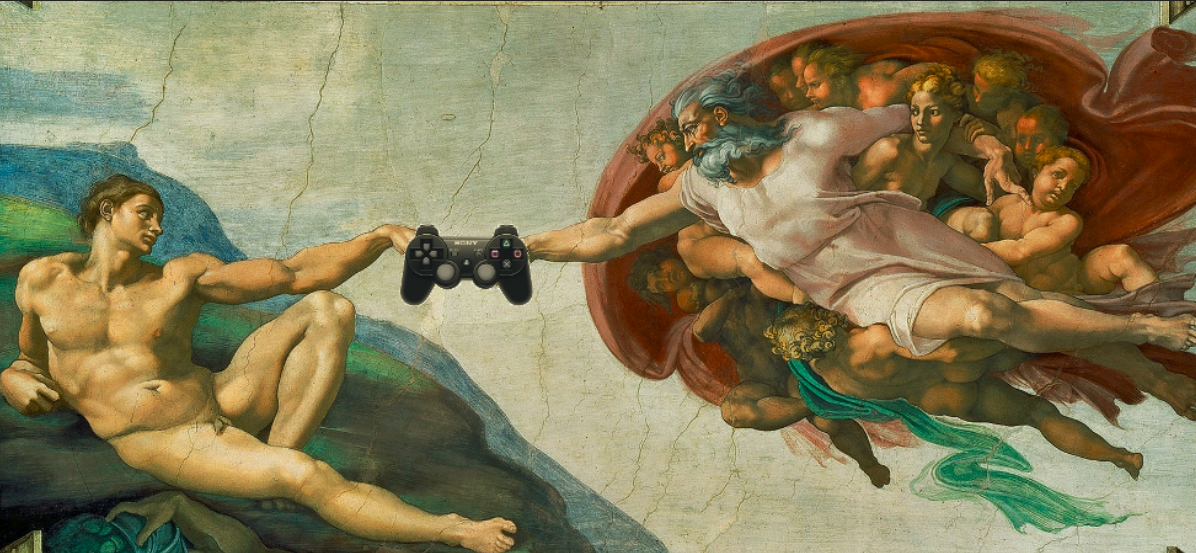
In my own view, the majority of video games are “secular,” meaning that they do not intend to proselytize, convert unbelievers, or instruct players or believers in the precepts of specific religious traditions. Yet, despite this so-called “secularization” (of entertainment media) or mediatization, religion retains a strong thematic presence in them.
To cite an almost ubiquitous example, death and resurrection are frequent such themes in video games (Ntelia 2015; Recher 2015). Players experience the death of their playable characters or avatars when they are killed by non-player characters (NPCs) in the virtual world or by the avatars of other online players inhabiting and competing in the same virtual space.
Death and resurrection may be exposed to players in many ways, including through ominous music, undead creatures, graveyards, ghosts, and other fictional characters (Wenz 2021, 508). Generally, dying is equated with failure for the player. It can also have negative consequences of various degrees for players, such as affecting the player’s rank or level, “resurrection sickness,” backtracking, costing resources needed for repairing damaged gear, or “permadeath” (the permanent death of the player’s avatar) (Wenz 2021, 509-510). The player therefore intends to develop the required skills to avoid this fate as much as possible during the playing experience (Curtis 2015). Many other examples of the representation of religion in video games exist.

Peter Molyneux, a well-known game designer, says that “Clearly God, the divine as a concept, plays a huge role in modern gaming. Virtually every fantasy role-playing game… explicitly includes the divine in the form of priests calling down healing prayers or smiting evil foes” (Murdoch 2010). According to the academic contributors to an online series on this topic by the Berkley Center for Religion, Peace & World Affairs, “the human construct with which video games have most in common isn’t television or literature or warfare but religion… It is a practice in rituals, ethics, moralities, and metaphysics” (Berkley Forum 2019).
Sociologist William S. Bainbridge, who has spent considerable time studying video games sociologically, says that through them the player “experiences a marvelous world, often for many hundreds of hours, frequently encountering religious symbolism” (2013, 3). These gaming virtual spaces allow players to experiment with new worldviews in which gods from diverse religious and mythological traditions coexist. They appeal to the “homo fantasia,” the fantasizing and imaginative human (Morehead 2010, 183).
References
Bainbridge, William Sims. 2013. eGods: Faith versus Fantasy in Computer Gaming. Oxford, England: Oxford University Press.
Berkley Forum. 2019. “How Does Video Game Religion Impact Life Off-line?” Berkley Center for Religion, Peace & World Affairs. Available. [accessed 19 May, 2024].
Campbell, Heidi A., and Grieve, Gregory Price. 2014. “Introduction: What Playing with Religion Offers Digital Game Studies.” In Playing with Religion in Digital Games, edited by Heidi A. Campbell and Gregory P. Grieve, 14-56. Indiana, United States: Indiana University Press (Apple Books pagination).
Curtis, Stephen. 2015, “To Fatality and Beyond: The Deathsetics of Failure in Videogames.” The Luminary. Available. [accessed 19 May, 2024].
Detweiler, Craig. 2010. Halos and Avatars: Playing Video Games With God. Louisville, Kentucky, United States: Westminster John Knox Press.
Love, Mark Cameron. 2010. “Not-So-Sacred Quests: Religion, Intertextuality and Ethics in Video Games.” Religious Studies and Theology 29(2):191-213.
Morehead, John W. 2010. “Cybersociality: Connecting Fun with the Play of God.” In Halos and Avatars: Playing Video Games with God, edited by Craig Detweiler. Louisville, Kentucky, United States: Westminster John Knox Press.
Murdoch, Julian, “God’s PR Problem: The Role of Religion in Videogames.” Gamespy. Available. [accessed 19 May, 2024].
Ntelia, Renata E. 2015. “Death in Digital Games: A Thanatological Approach.” Antea 2(2):90–100.
Recher, Kevin. 2015. “Game Over… and Then?: The Representation of Death and the Afterlife in Videogames.” Disputatio Philosophica 17(1):81-87.
Wenz, Karin. 2021. “Death and Resurrection.” In Encyclopedia of Video Games: the Culture, Technology, and Art of Gaming (2nd edition), edited by Mark J. P. Wolf, 508-513. Santa Barbara, California, United States: ABC-CLIO, LLC. (Apple Books pagination).
 Bishop's Encyclopedia of Religion, Society, and Philosophy
[…] a recognizable pattern including a beginning, a middle, and an end (Chandler and Munday 2020).See: Studying Religion in Video Games: Its Pervasive Thematic Presence (Part 1)See: Part 3 […]