The Merneptah Stele (c. 1200 BCE), also known as the Israel Stela and named after the titular pharaoh who ruled from 1213 to 1203 BCE, has been presented as evidence to support an early date for the biblical exodus. Currently housed in the Egyptian Museum in Cairo, this granite slab was discovered in Thebes in 1896 by British archaeologist Flinders Petrie (1853-1942).
See: The Biblical Exodus: The Story (Part 1)
See: The Biblical Exodus: Historicity, Maximalism vs. Minimalism, and Doubts (Part 3).
See: Rebutting the “Early Date” of the Exodus (Pi-Ramesses) (Part 5)
The Merneptah Stele is favored by some early date proponents because it putatively shows that Israel was an established nation at the time, a socioethnic status that would have taken years to develop. The scholarly consensus supporting an early date for the migration (around the thirteenth century BCE) would supposedly be undermined if this were the case (Hill and Walton 2009, 108). This argument, however, is not persuasive.

The pharaoh Merneptah’s reign was marked by warfare in Africa and the Ancient Near East, as historians know owing to the Merneptah Stele and The Great Karnak Inscription of Merneptah (c. 1208). In addition to his many triumphs over groups and settlements in Canaan, Merneptah also overcame troublesome tribes like the Libyans and the “Sea Peoples.” Since the Merneptah Stele is the first extra-biblical reference to a people called Israel, it is more valuable for our purposes. There is also no doubt about its authenticity (Kitchen 2003, 451; Moore and Kelle 2011, 115-116).
In the context of Merneptah suppressing rebellion in Palestine, line 27 of the Merneptah Stele references Israel’s defeat: “Israel is laid waste—its seed is no more.” This single string of words is “brief and enigmatic” (Andrews 2023, 86) and has frustrated historians because of its brevity and vagueness (Edelman 1996, 35-38), telling readers very little beyond Israel existing at the time somewhere in hill country (Moore and Kelle 2011, 116).
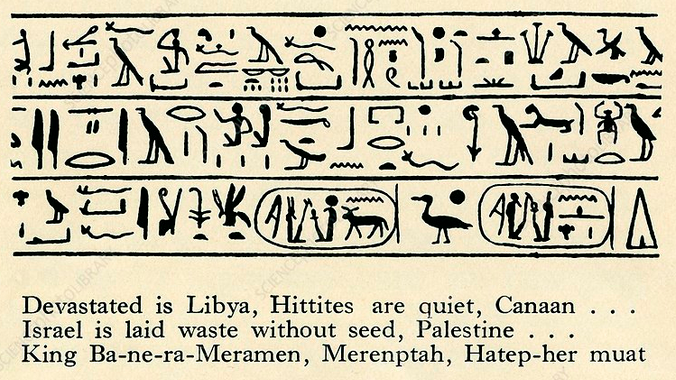
The inscription contains terms that have been debated. There is no longer any question that the stele refers to “Israel,” but there has been greater debate over what “seed” actually means (Hasel 1994; Andrews 2023, 87). Is “seed” a reference to the destruction of Israel’s agriculture, including crops and cattle, since Israel would have been an agriculturally based society at the time and destroying agriculture is an effective war strategy to induce starvation, or is it a way of saying that Israel as a people or tribe had been wiped out, inevitably eliminating any descendants? (Moore and Kelle 2011, 115).

Furthermore, the information provided by this artifact does not support the claim that the stela depicts Israel as a nation. In fact, something far less impressive was likely the case. Egytologist Kenneth Kitchen writes that “The Israel of Merenptah’s stela was, by its perfectly clear determinative, a people (= tribal) grouping, not a territory or city-state territory or city-state” (2003, 451). At this stage, “Israel” would have been a “tribal entity” (Kitchen 2003, 159). Israel existed “not as a country or city, but as a tribe” (Van Dijk 2000, 302) taking the form of a “a rash of new hamlets and villages” in twelfth-century Canaan (Kitchen 2003, 138). The majority of scholars therefore concur that it would be inappropriate to read too much into this vague statement generally let alone in support of an early date for the exodus.
Furthermore, another point to ponder is that in light of the biblical sources, the destruction of Israel mentioned in the Merneptah Stele raises challenging questions. The Book of Joshua describes successful inroads of Hebrews into Palestine in the wake of their flight from Egypt, yet the “only independent mention of the name Israel in this period—the victory stele of Merneptah—announces only that this otherwise obscure people, living in Canaan, had suffered a crushing defeat. Something clearly doesn’t add up when the biblical account, the archaeological evidence, and the Egyptian records are placed side by side” (Silberman and Finkelstein 2001, 87).
See: Part 5 [forthcoming]
References
Andrews, Edward D. 2023. Archaeology & the Old Testament. Cambridge, Ohio, United States: Christian Publishing House.
Hasel, Michael G. 1994. “Israel in the Merneptah Stela.” Bulletin of the American Schools of Oriental Research 296:45-61.
Hill, Andrew., and Walton, John H. 2009. A Survey of the Old Testament. Grand Rapids, Michigan, United States: Zondervan Publishing House.
Kitchen, Kenneth A. 2003. On the Reliability of the Old Testament. Grand Rapids, Michigan, United States: William B. Eerdmans Publishing Company.
Moore, Megan Bishop., and Kelle, Brad E. 2011. Biblical History and Israel’s Past: The Changing Study of the Bible and History. Grand Rapids, Michigan, United States: Wm. B. Eerdmans Publishing
Silberman, Neil Asher., and Finkelstein, Israel. 2001. The Bible Unearthed: Archaeology’s New Vision of Ancient Israel and the Origin of Its Sacred Texts. New York City, New York, United States: Free Press.
Van Dijk, Jacobus. 2000. “The Amarna Period and the Later New Kingdom.” The Oxford History of Ancient Egypt, edited by Ian Shaw, 461–463. Oxford, England: Oxford University Press.
 Bishop's Encyclopedia of Religion, Society, and Philosophy
[…] This entry will discuss the historicity of the exodus, the typologies of maximalism and minimalism in relation to this issue, and a few of the factors that have caused most historians to have doubts regarding the historicity of the biblical exodus as it is described in the biblical sources.See: The Biblical Exodus: The Story (Part 1)See: A Response to Christian Apologetic Uses of the Ipuwer Papyrus (Part 2)See: A Critical Response to the “Early Date” of the Exodus (The Merneptah Stele) (Part 4) […]
[…] placing it at some point in the thirteenth century BCE is more likely.See: The Story (Part 1)See: A Critical Response to the “Early Date” of the Exodus (The Merneptah Stele) (Part 4)See: Part 6 […]