The Aztecs were a Mesoamerican people living in Mexico from 1300 to 1521 CE, before the Spanish conquest of the sixteenth century.
The Aztecs originated from an alliance of hunter-gatherers in the Valley of Mexico who became the dominant force in the region. They were also primarily agricultural people who lived off of the land and grew the likes of maize, beans, squashes, potatoes, tomatoes, and avocadoes, and regularly engaged in the hunting and fishing.
The heart of their empire was the capital city, Tenochtitlan. Prior to the founding of Tenochtitlan, central Mexico consisted of city-states that competed for dominance in the region. Tenochtitlan, founded in 1325 on a small island, became the most powerful and expanded to such an extent that it became the largest in the Pre-Columbian Americas. It was home to a complex social system consisting of numerous classes, from slaves to ordinary commoners, nobles, merchants, and the king. Rulers were believed to be representatives of God and therefore ruled with divine right.
The social class of citizens could be identified by where they lived in the urban environs. It also boasted a lively market, as many tens of thousands of visitors would descend on the city on major market days. At Tenochtitlan’s height and at the time the Spanish arrived, it had a population well over 100,000.
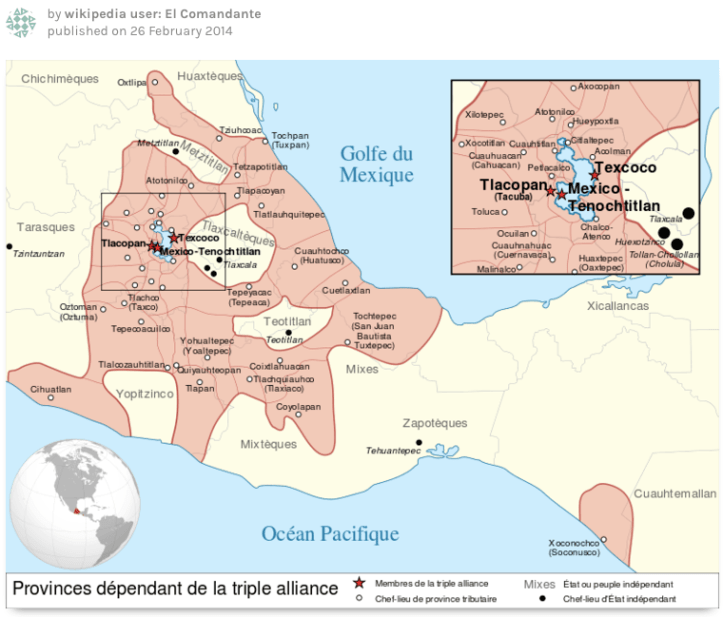
The empire grew powerful primarily because of its military power. Its military encompassed a range of combatants, including elitist warriors, as well as the available men from captured city-states. These other city-states, although under Aztec rule, were still allowed to have their own rulers, although they were required to pay a tribute and supply soldiers to the empire if needed.
The Aztecs are remembered for their art and archeology, some of which were the most sophisticated in the region. They constructed elaborate structures, including palaces, plazas, temples, and statues, many of which were dedicated to gods. In terms of religious beliefs, the Aztecs were both polytheistic and animistic. They believed in a pantheon of major and minor deities. They had two principal deities, Huitzilopochtli (the war and sun god) and Tlaloc (the rain god), and believed in many others, including, although not limited to, Quetzalcoatl (the feathered serpent god), Xipe Totec (the god of spring and agriculture), and Ometeotl (the creator god).
The Aztecs also clearly had a fascination with the sun which they incorporated into their mythologies. This included the rite of human sacrifice, which was essential for the continual revival of the sun as well as the continual fertility of the earth. Blood was always required and included the sacrifices of both animals and humans during ceremonies. Often, the priests were required to self-mutilate. The sacrifices, mostly of war prisoners and captives, were sometimes eaten, thus suggesting that cannibalism was part of at least some of the ceremonies. These rituals were meant to be displays of power, divine authority, and a warning to others about what would happen if they rebelled.
Hernán Cortés (1485–1557), a Spanish conquistador and expedition leader, and his soldiers and accompanying Tlaxcalan warriors invaded Tenochtitlan, capturing its king, Cuauhtémoc (c. 1497–c. 1525).
 Bishop's Encyclopedia of Religion, Society, and Philosophy
[…] Aztecs were an agricultural people living in Mexico from 1300 to 1521 CE. Religiously, the Aztecs were […]
I believe the photo is of Chichen-Itza, which is Mayan, not Aztec.