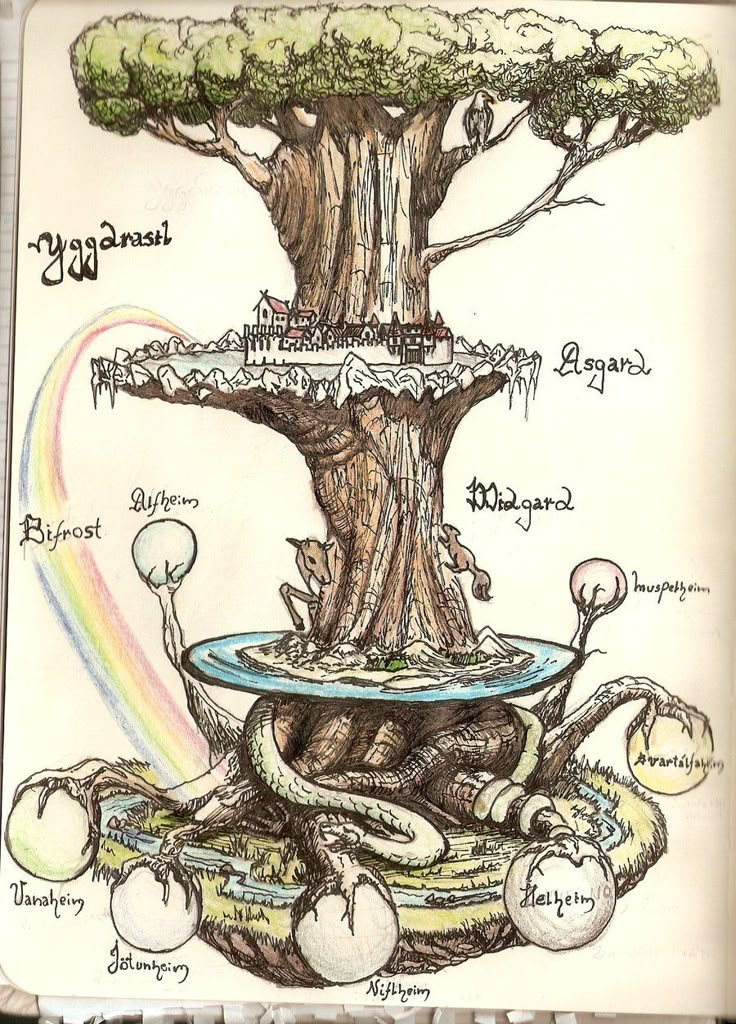
Yggdrasil, which means “the horse of the terrible one” (a reference to the supreme god Odin), is a huge evergreen ash tree located at the center of the earth, with three roots, one extending to Niflheim (the underworld), one to Jotunheim (land of the giants), and one to Asgard (land of the gods). According to the poem The Lay of Grimnir (d. 10th century CE), “Of all trees, Yggdrasil is the best.”
The concept of Yggdrasil is essential to the Norse or Scandinavian populations, also known as the Vikings (meaning “raider” or “raiding”), who inhabited Europe’s far northern areas, roughly the period between 790 and 1050 CE, during the Middle Ages. Although known today mostly for their warrior status, the Norse were primarily traders, farmers, and sailors.
Yggdrasil joins the sky to the earth, the light to the dark, and thought to matter. According to the Icelandic historian and poet Snorri Sturluson (1179–1241), “its branches spread out over the whole world and reach up over heaven.”
The Nine Realms concept is the pre-Christianized cosmological belief of the Norse and refers to the homelands of various creatures (dwarves, spirits, gods, giants, and human beings) that are held together by Yggdrasil.
Many animals live in Yggdrasil’s branches and roots. An eagle perches in its upper branches while a dangerous serpent called Nidhogg eats at its roots. Four deer (Dainn, Dvalinn, Duneyrr, and Durathror) nourish themselves on its foliage while a squirrel, Ratatoskr, scurries along the trunk, conveying the serpent’s insults to the eagle and vice versa.
The tree’s origins are timeless, and it will survive Ragnarok, the end of the world according to Norse mythology, and protect the man and woman who will repopulate the world. The gods are portrayed as riding out each day “from Yggdrasil” to deal out fates to humankind. It was also on it that the supreme Odin willingly sacrificed himself by hanging in torment for nine long nights before he could seize the runes of power.
The nine realms are set in three layers. At the top are Asgard, Vanaheim, and Aflheim; in the middle, linked to Asgard by the rainbow bridge Bifrost, are Midgard, Jotunheim, and Nidavellir/Svartalfheim; below are Muspelheim, Niflheim, and Helheim.
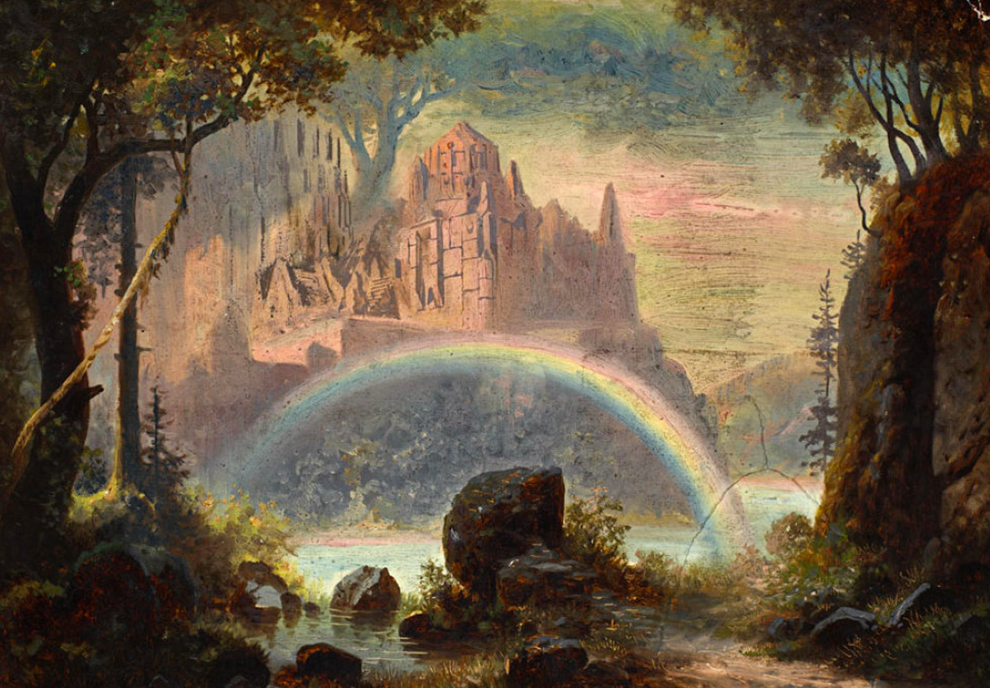
Asgard—This place can be likened to the Olympus of Greek mythology. It is the realm, often associated with gold imagery, inhabited by the gods and ruled by Odin, the supreme deity and creator. Some other major deities from this realm include Frigg, Odin’s queen; Thor, the master of Mjolnir; Balder, the good; the one-handed Tyr; Brage, the songsmith; Idun, the goddess of youth; and Heimdal, the watcher of Asgard.
Asgard is also the location of the great hall known as Valhalla, the abode of Odin and heroes slain in earthly battle. This is described as a palatial hall built with shields and spears and contains 540 doors.
“There [Asgard] dwelt the gods and their race, and thence were wrought many tidings and adventures, both on earth and in the sky. In Asgard is a place called Hlidskjalf [Valhalla], and when Odin seated himself there in the high−seat, he saw over the whole world, and what every man was doing, and he knew all things that he saw. His wife hight Frigg, and she was the daughter of Fjorgvin, and from their offspring are descended the race that we call asas [Aesir], who inhabited Asgard the old and the realms that lie about it, and all that race are known to be gods. And for this reason Odin is called Alfather, that he is the father of all gods and men, and of all things that were made by him and by his might.” (The Prose Edda 2001, 20).
Vanaheim—The realm of the Vanir, or fertility and wisdom gods. The god of the wind and of the sea, Njord, also the father of gods Freyr and Freyja, was raised here and was “invoked by seafarers and by fishermen. He is so rich and wealthy that he can give broad lands and abundance to those who call on him for them” (The Prose Edda 2001, 30).
Alfheim—The homeland of the Elves, beautiful demigod-like beings. The Vanir god Freyr, the ruler of peace and fertility, rain, and sunshine, was possibly the ruler of this realm, although Alfheim is scantily described in sources. It might have been a realm of light and beauty: “Are there other remarkable places than the one by Urd’s fountain? Answered Har: There are many magnificent dwellings. One is there called Alfheim” (The Prose Edda 2001, 27).
Midgard—The world of human beings located between the land of the gods and that of the dead that is made from the body of the first created being, the giant Aurgelmir. Gods killed Aurgelmir and made Midgard from his body. Aurgelmir’s skull became the dome of the heavens, and the sun, moon, and stars were made from scattered sparks that were caught in this skull.
“And Fimbultyr said: Let Ymer [Aurgelmir] be slain and let order be established. And straightway Odin and his brothers−−−the bright sons of Bure−−−gave Ymer a mortal wound, and from his body made they the universe; from his flesh, the earth; from his blood, the sea; from his bones, the rocks; from his hair, the trees; from his skull, the vaulted heavens; from his eye−brows, the bulwark called Midgard” (The Prose Edda 2001, 2).
The evil, giant serpent Jormungand, whose body encircled the world, lived in Midgard, after he was thrown “into the deep sea which surrounds all lands. There waxed the serpent so that he lies in the midst of the ocean, surrounds all the earth, and bites his own tail” (The Prose Edda 2001, 32). Jormungand often battles the warrior god Thor, and both will slay each other during Ragnarok, the end of the world.
Midgard was also the home of the first man and woman, Ask and Embla, who were created by gods who “formed man and women in their own image of two trees, and breathed into them the breath of life. Ask and Embla became living souls, and they received a garden in Midgard as a dwelling−place for themselves and their children until the end of time. This was Cosmos” (The Prose Edda 2001, 2).
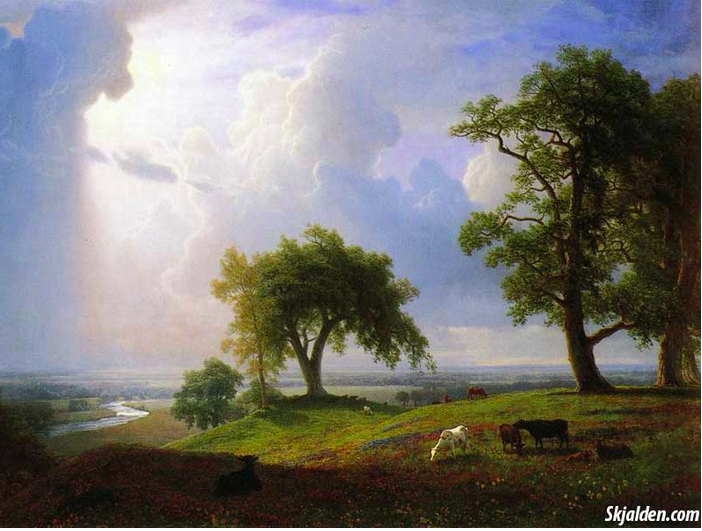
Jotunheim—The realm of the giants, called Jotuns, located among the roots of Yggdrasil and depicted with deep, dark forests, and mountain peaks. These giants fought the gods for possession of the world. At Ragnarok, which will follow the trembling of Yggdrasil signaling its impending arrival, there will be a final battle between gods and giants.
Nidavellir/Svartalfheim—The home of pitch-black dwarves (sometimes described as “black elves”), made in the likeness of men, and a group of skillful smiths and craftsmen who live beneath the ground in mines and forges and in rocks (The Prose Edda 2001, 22). The dwarves produced magnificent items, including Thor’s hammer, Mjolner; the most skillfully crafted ship in Norse mythology belonging to the goddess Freyr, called Skidbladnir; and Odin’s spear, Gungnir.
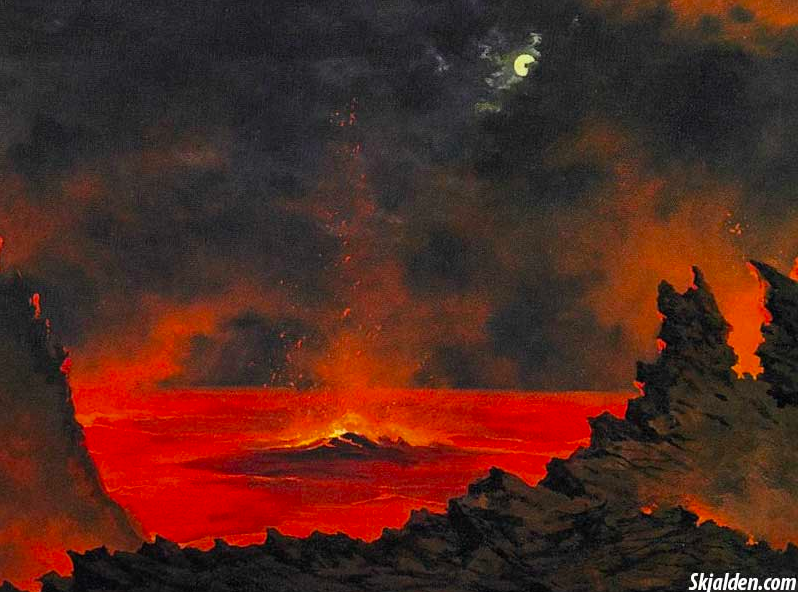
Muspelheim—A hot, bright, glowing land guarded by Surt, the fire giant, who “has a flaming sword in his hand, and at the end of the world he will come and harry, conquer all the gods, and burn up the whole world with fire” (The Prose Edda 2001, 16). The air from this region is so “light and hot, and so bright and dazzling that no stranger, who is not a native there, can stand it” (The Prose Edda 2001, 16). It melted the ice of the opposite region, Niflheim, thus giving form to Aurgelmir, the father of the evil giants.
Niflheim—The “cold and all things grim proceeded from Niflheim” (The Prose Edda, p. 17). It is a realm of eternal cold and darkness with a collection of eleven rivers, called the Elivogs, which flow from a well called Hvergelmir.
“Said Ganglere: What took place before the races came into existence, and men increased and multiplied? Replied Har, explaining, that as soon as the streams, that are called the Elivogs, had come so far from their source that the venomous yeast which flowed with them hardened, as does dross that runs from the fire, then it turned into ice. And when this ice stopped and flowed no more, then gathered over it the drizzling rain that arose from the venom and froze into rime, and one layer of ice was laid upon the other clear into Ginungagap” (The Prose Edda, p. 17).
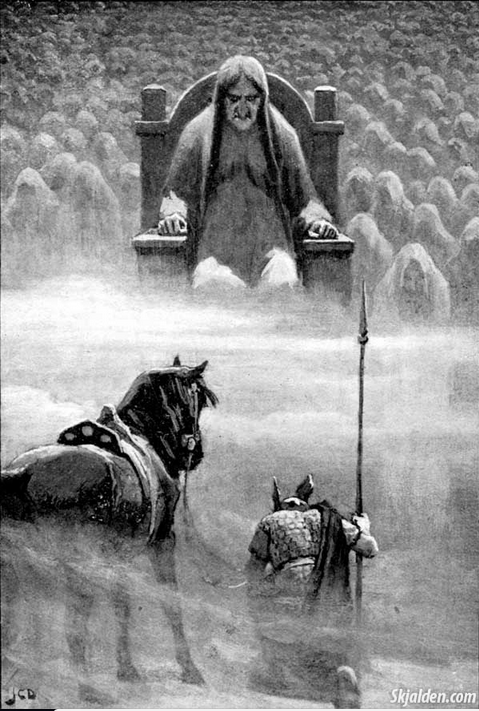
Helheim—Ruled by the goddess of death, Hel, who is also the daughter of the trickster fire god Loki, Helheim is the underworld and the lowest of the Nine Realms where the dead are located. It is not a place of torment and was said to be reserved for those who died of old age or illness. Helheim’s entrance is guarded by Garmr, a monstrous wolf covered in blood, who will escape from his bind before the Gnipa-cave to fight at Ragnarok.
References and Recommendations
Blackmask Online. 2001. The Prose Edda. PDF. Downloadable.
Thorpe, Benjamin. 2004. The Poetic Edda. Lapeer, Michigan, United States: Northvegr Foundation Press.
Visit Norse Mythology for Smart People and Britannica for information on Norse Mythology.
 Bishop's Encyclopedia of Religion, Society, and Philosophy