The Zealots was a movement or coalition of bandits, terrorists, and the unemployed that emerged in 66/67 CE and took up arms against the Romans occupying Palestine. The name itself comes from Greek zēlōtēs, from zēloun “be jealous,” from zēlos “zeal.”
See Banditry in the Time of Jesus: Champions of the Oppressed Peasantry
See Banditry in the Time of Jesus: Exploitation, Famine, and Leadership
__________________________________________________________
There is no historical relationship between the Zealots and other rebel groups such as the Fourth Philosophy and the Sicarii, who have also erroneously been viewed as “the Zealots” (Horsley and Hanson 1985, 248).
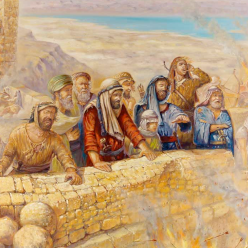
Because of their priestly orientation, the Zealots were careful to maintain control of the running of the Second Temple after they took it over in 67–68 CE until its destruction in 70 CE.
An important achievement of theirs lay in deposing the dynasties of the priestly oligarchy and instituting the election of a high priest by lot. This was to implement a more egalitarian theocracy by democratizing the institution of the high priesthood and instituting collective decision-making. As shortly observed, their political strategy involved bringing to justice those ruling groups and persons they believed were oppressive.
Most of what we know about the Zealots comes from first-century historian Flavius Josephus (37–c. 100 CE) and his Jewish Wars (75 CE). Among rebel groups and messianic movements, the Zealots were particularly despised by Josephus, as perhaps indicated in the following description:
“In this [complete lawlessness] the Zealots excelled, a group whose deeds verified its name. They faithfully copied every ruthless deed, and there was no crime on record that they failed to commit. Yet they took their name from the fact that they were zealous for what was right, either ridiculing those injured, brutal types that they were, or regarding the worst evils as good” (J.W. 7.268-270).
Josephus explains that the Zealots originated as a coalition of brigand groups who had entered Jerusalem from the countryside in late 67 CE.
“When at last the chiefs of the scattered brigand bands had had enough of raiding the countryside, they joined forces, forming a single pack of thugs, and infiltrated Jerusalem…” (J.W. 4.135).
“Fresh brigands from the countryside slipped into the city and joined the more formidable gang within, missing no opportunity for heinous crime…” (J.W. 4.138).
It was therefore the coalescing of various bandit groups in Jerusalem, during a time in which Jewish banditry had reached epic proportions, that formed the Zealots proper (Horsley and Hanson 1985, 202, 223).
Josephus says that these groups no longer limited their crimes to raids and highway robberies but committed murder, evidently during day or night time, openly or clandestinely. The even targeted distinguished citizens and nobles. First to be seized and imprisoned was Antipas, an individual of royal descent who was entrusted with the public treasury. After him came Levias, one of the nobles, and Syphas son of Aregetes, both of royal blood, then others of high reputation (J.W. 4.139-41).
These acts were not random or irrational but deliberate in terms of both the individuals targeted for purging and the procedures that followed. Their anger rested upon the Herodian nobles with whom they had “ancient quarrels” and believed betrayed Jerusalem into the hands of the Romans (J.W. 4.140-146).
A series of purges occurred, first shortly after entering Jerusalem, then alongside the Idumeans who had rescued them from imprisonment in the temple (J.W. 4.325–327), and then a third phase after most of the Idumeans had left the city (J.W. 4.357).
“The Zealot purges were part of an overall pattern of popular attacks on the ruling aristocracy throughout the revolt. At the very beginning of the revolt, those who cut off the temple sacrifices for Rome, along with other rebels, attacked the high priestly aristocracy and Herodian nobles, besieged them in the royal palaces, and executed those whom they captured, such as the high priest, Ananias, and his brother Ezechias (J.W. 2.430-41)” (Horsley and Hanson 1985, 224).
By lot, the Zealots elected commoners to high priestly offices, even installing a villager as the high priest. These actions were viewed by many as attempts by the Zealots to put themselves in roles of power, which alarmed the high priestly leaders who decided to organize an attack on them (J.W. 4.147-157).
High priests such as Ananus and Jesus son of Gamala marshaled a fighting force among the Jerusalemites (J.W. 4.158-95) and successfully drove the Zealots into the temple courtyard and then into the inner court (J.W. 4.197-204).
From the temple, the Zealots appealed to allies from the villages and towns of Idumea (the district south of Jerusalem and Judea) for help (J.W. 4.224-232). Hearing the call and overcoming Ananus’ forces, the Idumeans entered the city and liberated the trapped Zealots from the inner court of the temple, then killed Ananus and Jesus son of Gamala, among others. Together, the Idumeans and Zealots purged more young nobles before most of the Idumeans finally withdrew from the city (J.W. 4.233-253).
Soon experiencing Roman siege, rival Jewish groups (e.g., the Sicarii, John of Gischala, and Simon bar Giora) in Jerusalem began resisting the Roman forces instead of fighting each other. The majority died in the siege of Jerusalem. After Masada fell in 73 CE, those who fled to Egypt were rounded up, tortured, and executed. Despite having fought against the alien Roman occupiers, the Zealots were first fighting a class war against their own Jewish nobility.
References
Hobsbawm, E. J. 1965. Primitive Rebels. New York: Norton.
Hobsbawm, E. J. 1981. Bandits. New York: Pantheon.
Horsley, R. A., and Hanson, J. S. 1985. Bandits, Prophets, and Messiahs: Popular Movements at the Time of Jesus. Winston Press.
 Bishop's Encyclopedia of Religion, Society, and Philosophy