African Traditional/Indigenous Religions (ATRs) refers to what can be known historically about the religious life and practices of particular African societies prior and subsequent to extensive encounters with Islam and the colonial West. These religions continue to exist in various forms and have a presence among contemporary African cultures.
ATRs are localized, kinship-based, nonmissionary religions with inarticulate, multi-stranded, and pragmatic beliefs aimed at securing optimal material health for the community, primarily through ritual activity.
Although each of these characteristics can be discussed in detail, what is immediately apparent are the humanistic and communal dimensions of ATRs.
ATRs are pragmatic given their emphasis on obtaining tangible benefits in this life and inextricably bound to society and community.
Africans, being, as famously described by scholar John Mbiti (1931-2019), “notoriously religious,” do not posit a sacred and secular dichotomy. There is no splitting social reality into the secular versus the religious. Instead, religion is an assumed fact of social reality and inseparable from other cultural practices, in particular kinship relationships. The world, society, and nature are home to various spiritual forces.
ATRs are not individualistic but communal. Festivals, feasts, dances, and artistic expressions celebrate communal existence, both of the living and the dead. Good health and healing entail the preservation and/or restoration of human vitality in the context of the community as a whole,
“Healing is the restoration of a disharmonious relationship between an aspect or aspects of life to a harmonious balance. It is not simply the elimination of disease or physical “inability to function in normal activity” but the restoration of a disturbed cosmic/spiritual/metaphysical order either as it relates to an individual or to a family or a whole clan” (Ukah 2016, 56).
Ultimately, health depends on right human relationships and harmony with the spirit world, particularly with the ancestors.
Africans are invested in the present moment and not in a future existence after death. Material advantages are emphasized, as these promote the well-being of the community as a whole. Communication with spirits in rituals is the method of achieving this end.
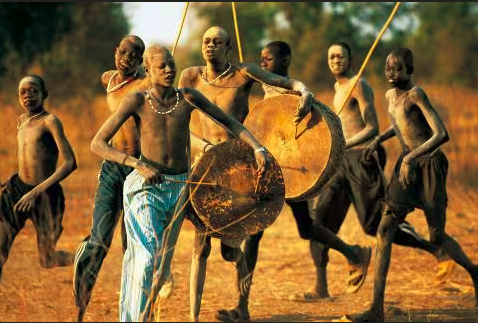
Rituals take place in communal settings. For the Dinka, a tribe located in the Nile basin in Southern Sudan, prayer, perhaps the most important part of their religious practice, is collective and formal and entails offerings made to the clan-divinities (ancestors) with the hope of controlling the normal world order and guaranteeing health and success.
ATRs can be considered a form of humanism because religious activity focuses on how positive benefits for human society can be actualized.
ATRs intend to enhance the quality of human life. Spiritual forces and powers are sources for achieving this. Propitiating, acknowledging, and caring for ancestors can produce boons and good fortune, such as rain to ensure the abundance of crops, the health of the cattle, keeping death and witchcraft at bay, or ensuring healthy offspring (Ikenga-Metuh 1987).
The Ashanti make offerings such as the first morsel of food as well as pour libations to the ancestors daily. But the ancestors can also punish individuals with illness and death, especially those who have violated traditional laws and customs or fail to fulfill kinship obligations. On the other hand, they can bless their kinsmen with plentiful crops, children, and prosperity.
The Bangwa of Cameroon visit sacred places, “fuandem,” such as waterfalls or other natural features, where a chief or subchief makes offerings for the fertility and well-being of the land.
On the other hand, witchcraft or angering spirits, gods, or ancestors can lead to misfortune, illnesses, and catastrophes commonly afflicting communities. This gives traditional healers, diviners, and shamans considerable cultural power and prestige since they offer the remedy to healing these afflictions. Misfortune could be due to violating social norms, and it is the traditional healer’s duty to perform rituals to communicate with the spirits or ancestors to learn what this violation is.
ATRs are therefore reciprocal. Reciprocity between the community and the spirits is the primary manner through which tangible benefits are acquired and maintained. Such entails providing gifts to the spirits, usually in the form of sacrificed animals, as a sign of respect and remembrance.
Among the Igbo people of Nigeria, most homes had ancestral shrines at the corner of the hut, and offerings were made regularly to the ancestors. Spirits of ancestors, without receiving the appropriate ceremonies, would harass the living. The Bangwa people exhume the skulls of their ancestors, who are then kept in a special house in a compound and “fed” and consulted about important decisions using various forms of divination.
References
Ukah, Asonzeh. 2016. “Religion in the Pre-Contact Old World: Africa”. In The Cambridge History of Religions in Latin America, edited by Virginia Garrard-Burnett, Paul Freston, and Stephen C. Dove, 47-61. Cambridge: Cambridge University Press.
Ikenga-Metuh, Emefie. 1987. “The Living Dead and Ancestral Cult.” In Comparative Studies of African Traditional Religions, edited by Emefie Ikenga-Metuh, 145-159. Onitsha: Imico Publishers.
 Bishop's Encyclopedia of Religion, Society, and Philosophy